
2026 NBA Draft Forecast
How will this year's draft class fare in the NBA? I used a statistical model to forecast every college prospect's probability of becoming a star, a contributor, or a bust.


Hello, everybody!
Welcome to the landing page for my 2026 NBA Draft Model!
Here you’ll find the probability of each college prospect landing in one of three outcome tiers — Star (xRAPM > +3), Contributor (0 to +3), or Bust (< 0) — based on a model I built that uses their college statistics, player profile, and other variables found to be predictive in out-of-sample testing.
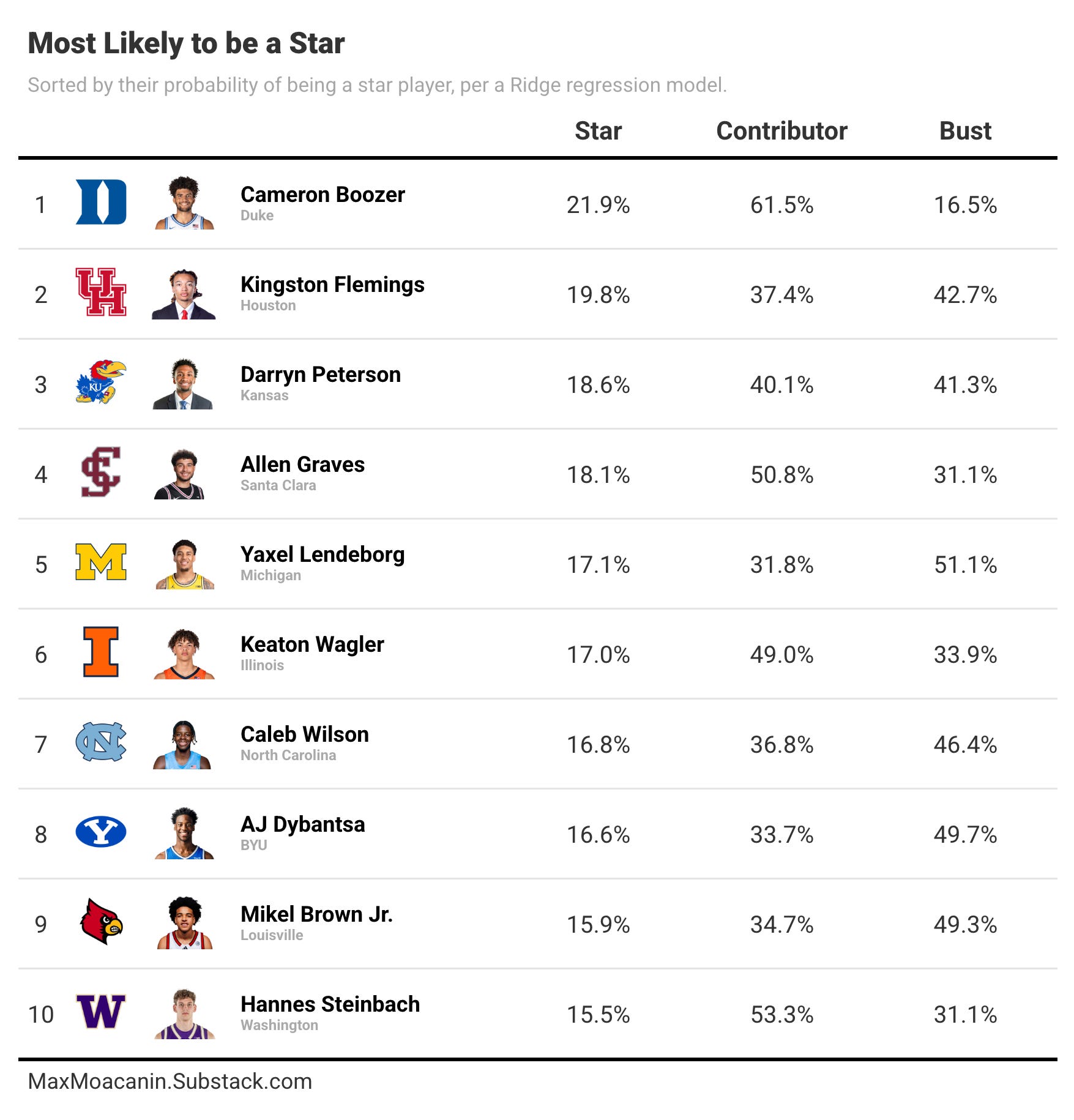
One of the model’s most surprising findings: AJ Dybantsa, the consensus No. 1 overall pick, ranks 8th in star probability at 16.6 percent, and has a 49.7 percent chance of being a bust.
However, it should be noted that, since an xRAPM of 0 represents an average NBA player, roughly half of all NBA players qualify as “busts” by this definition, making it a higher bar than the term might suggest.
Ultimately, predicting how good college basketball players will be in the pros is a difficult task using data alone. Some important variables, such as work ethic or future injuries, are difficult or impossible to quantify. James Wiseman is a good example. The model was remarkably high on him, but multiple major injuries derailed his career in ways no amount of available data could have reliably predicted.
That being said, the model has made some calls right that the consensus missed, like correctly valuing Pacers All-Star Tyrese Haliburton well above his draft slot of 12th in 2020.
All this is to say: these predictions are my best guess given historical trends and the data available on each player before they entered the NBA.
In the coming days, I’ll be diving into some of the model’s more curious predictions. I’ll likely start with why the model is so high on Santa Clara forward Allen Graves.
I hope you enjoy!
Use the Table of Contents below to navigate:
Table of Contents
Most Likely Stars
Here are the 10 players who are most likely to have an xRAPM higher than 3.0 during their NBA career.
Least Likely Busts
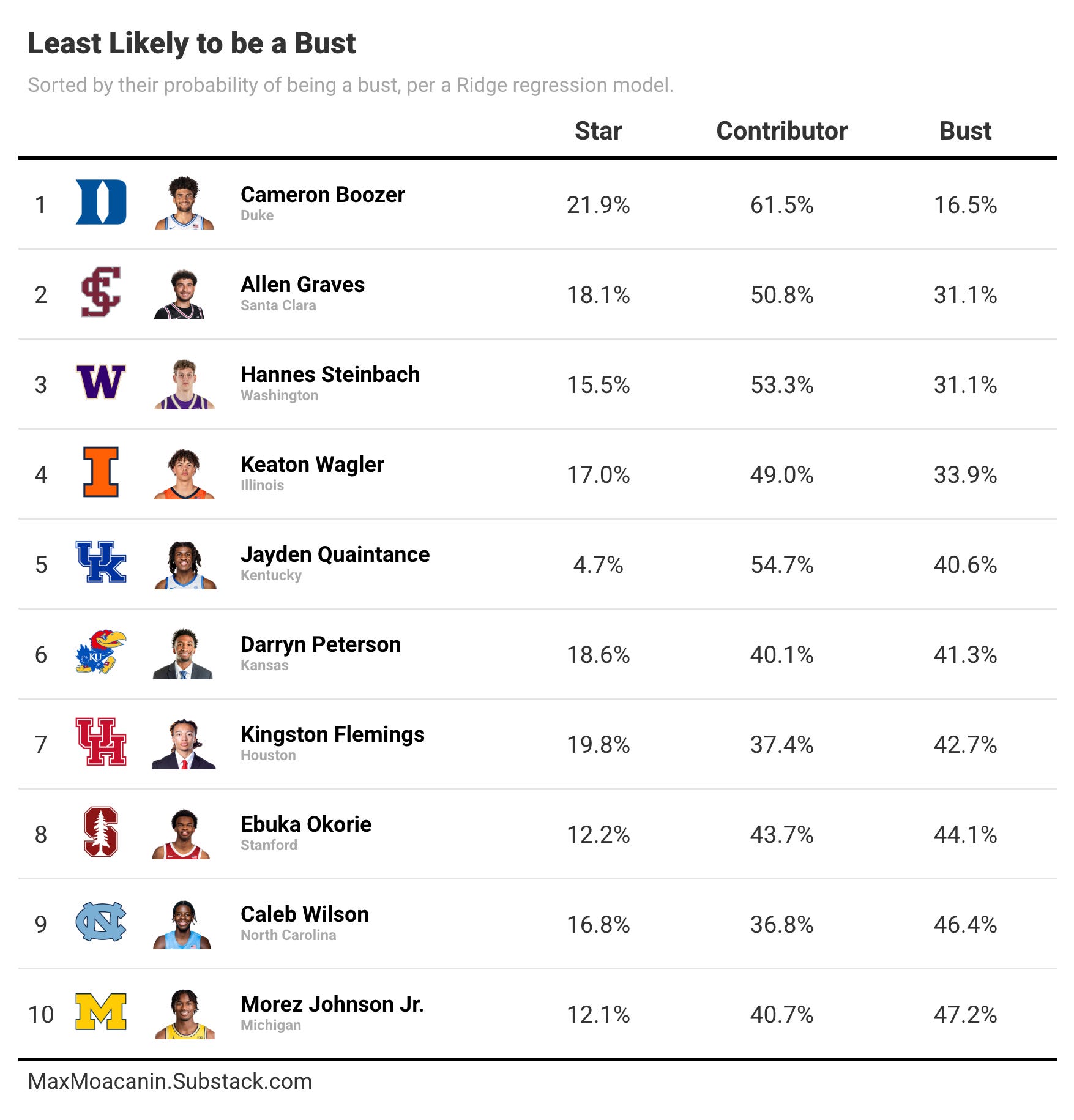
Here are the 10 college prospects in this year’s draft who are least likely to have an NBA career with an xRAPM below 0.
Full Table
A full breakdown of 33 college prospects who are eligible for the 2026 NBA Draft.
Walk-Forward Predictions
In-Sample Predictions
Methodology
The model predicts the probability of each college prospect landing in one of three outcome tiers: Star (xRAPM > +3), Contributor (0 to +3), or Bust (< 0).
Data
The foundation is Jeremias Engelmann’s publicly available NBA Draft model dataset, which provides college statistics and xRAPM-based player impact estimates — along with their standard errors — for all major college prospects since 2010. I also incorporated biographical information such as whether a prospect’s father played in the NBA.
I explored using NBA combine data as well, but ultimately excluded it due to selection bias. Top prospects frequently skip the combine, making the data systematically missing for exactly the players most relevant to the model.
Model
Rather than treating the three NBA outcomes as hard 0/1 labels, I used the impact estimate and its standard error to compute a probability of landing in each tier via the normal CDF. This approach, inspired by Jeremias Engelmann’s draft modeling work, means a player like Derrick White (xRAPM +2.6, SE 1.0) gets a 34.5 percent star probability and a 65.1 percent contributor probability, appropriately reflecting the uncertainty in this estimate.
Three separate models were built, one per tier, trained on draft classes from 2010-2019 and validated on 2020-2022. Players were weighted by 1/SE² so prospects with more NBA playing time — and therefore more reliable impact estimates — influenced training more heavily. The test set was capped at 2022 because players drafted more recently have limited NBA experience and therefore unreliable outcome labels.
I tested several machine learning algorithms including Ridge regression, Lasso regression, and gradient boosted trees (LightGBM). Ridge regression consistently outperformed the alternatives on the holdout set. Final models use Ridge regression with cross-validated regularization strength.
Features were selected iteratively using coefficient magnitude as a guide, with each tier’s model independently optimized. Key predictors for star probability include free throw percentage, log of draft position, blocks per 100 possessions, age, and field goal percentage near the basket.
It’s almost like Cam Boozer should be the consensus best player in the draft.
Otherwise, I enjoyed the piece and the approach, particularly the player buckets.