

I know I’ve said this many times but: I am a big fan of the Denver Nuggets. And today I am going to tell you why I’ve loved the addition of Tim Hardaway, Jr. to the team this season.
For those of you who don’t watch the Nuggets as regularly as I do, I am going to summarize Hardaway’s role on the team as succinctly as I possibly can: he comes in off the bench and mostly jacks up threes.
And it’s great!
This strategy goes against everything I remember being taught when I played basketball as a kid. (In high school, I played three years of varsity basketball for what was probably the worst team in all of San Diego County. And, to paraphrase from a Sam Elliott line in The Big Lebowski, that put us high in the running for worst worldwide.) We were always told to move the ball around and look for a “good shot.”
That’s clearly not what Nuggets coach David Adelman has been telling Tim Hardaway, Jr. If he gets the ball and he’s even kinda open, he has the green light to let it fly.
This strategy has been great for at least three reasons.
The first reason is that Hardaway is a highly efficient three-point shooter.
He shot 40.7 percent from beyond the arc this season. Some simple back-of-the-envelope math would thus suggest that the Nuggets score 1.22 points per possession when Hardaway shoots a three.
For context, the Nuggets led the league in offensive rating this season by scoring 1.21 points per possession. So, in theory, a hypothetical offense based entirely on Tim Hardaway, Jr. three-point shots would have had the highest offensive rating in the league this season.
What’s more, this calculation doesn’t even take into account the possibility of an offensive rebound or Hardaway getting fouled. And the latter happens quite a bit.
Tim Hardaway, Jr. was one of the most frequently fouled three-point shooters in the NBA this season. He drew a foul on 21 of his three-point shots. The only players that were fouled more often on threes this season were James Harden, Norman Powell, Julian Champagnie, and Steph Curry.
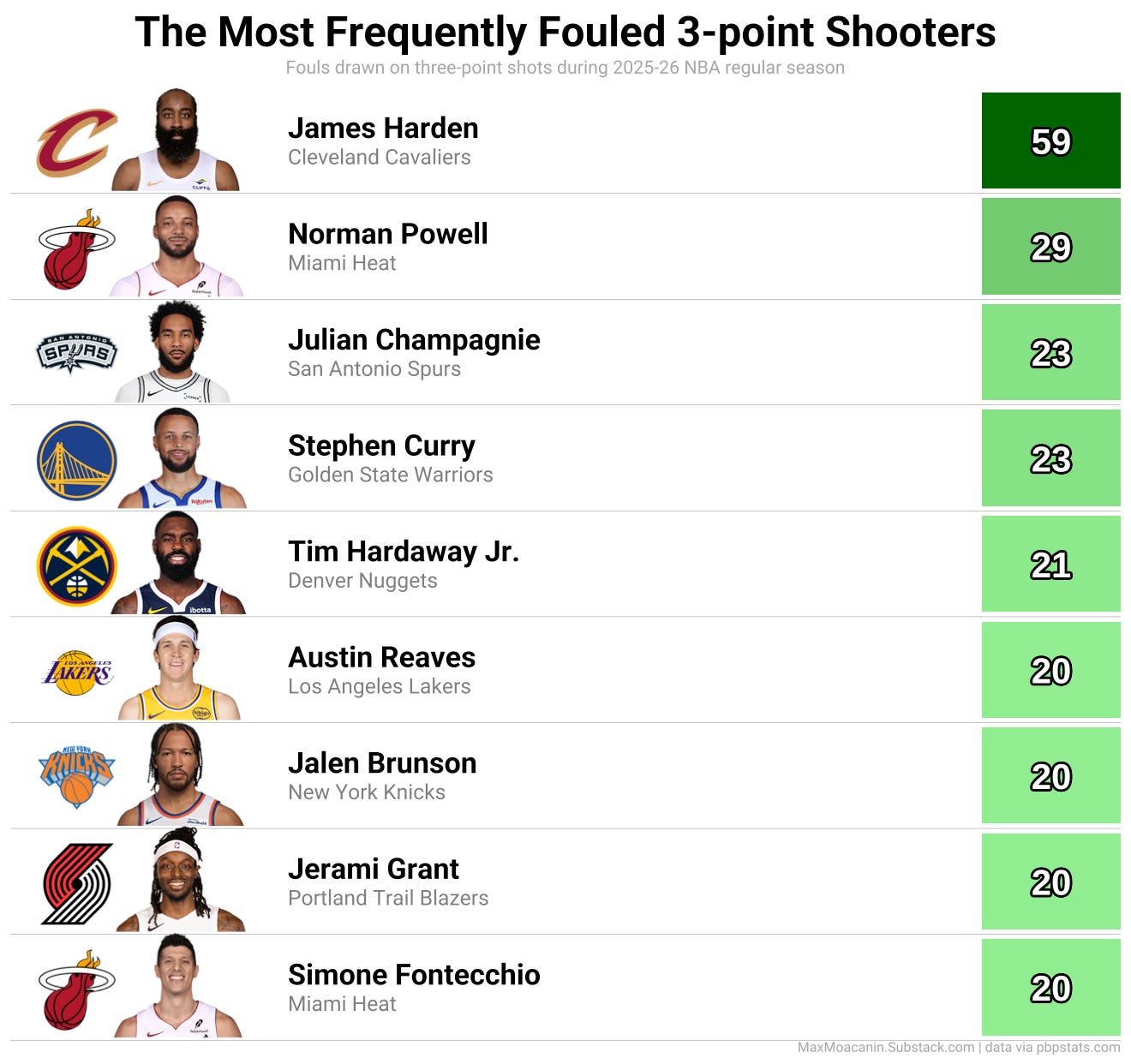
This has been great for the Nuggets because drawing a foul on a three-point shot is the most valuable play in basketball. According to analysis done by John Hollinger for The Athletic in 2019, the expected value of getting fouled on a three-point shot is 2.56 points. Hollinger found that a typical shot during the 2018-19 season was worth 1.10 points. So a foul on a three-point shot is worth more than twice as much as a typical NBA play.
It’s worth pausing to note: James Harden’s lead in this stat is absurd. He drew 59 fouls on three-point shots this season, more than double anyone else.
The second reason I like this strategy is that it seems to limit turnovers.
By having an efficient catch-and-shoot specialist like Hardaway, the Nuggets have created an offense that reduces opportunities to turn the ball over. Every extra pass introduces another chance for something to go wrong, and Hardaway’s role often cuts that chain short. He isn’t just shooting the lights out; he’s finalizing possessions before a turnover can happen.
That kind of role has real consequences at the team level. The Nuggets reduced their turnover rate significantly this season. Last year, they ranked 13th in the NBA with a turnover rate of 14.0 percent. This season, they ranked second with just 12.8 turnovers per 100 possessions.
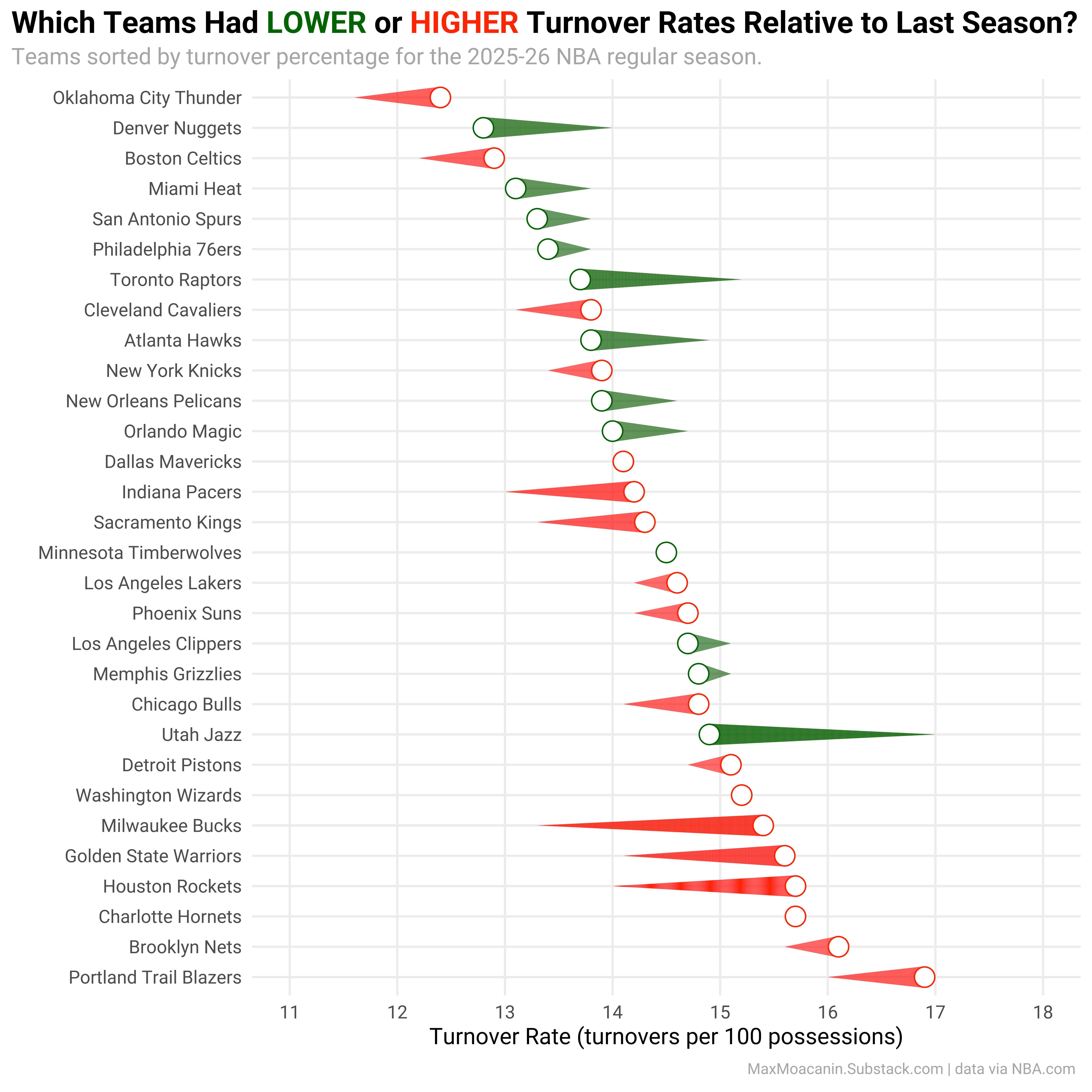
The Nuggets had the third-best year-over-year improvement in turnover rate, trailing only the Utah Jazz and Toronto Raptors.
It’s impossible to isolate exactly how much of this improvement is due to Hardaway. But it’s certainly not negligible given that he had the lowest turnover rate in the entire league this season.
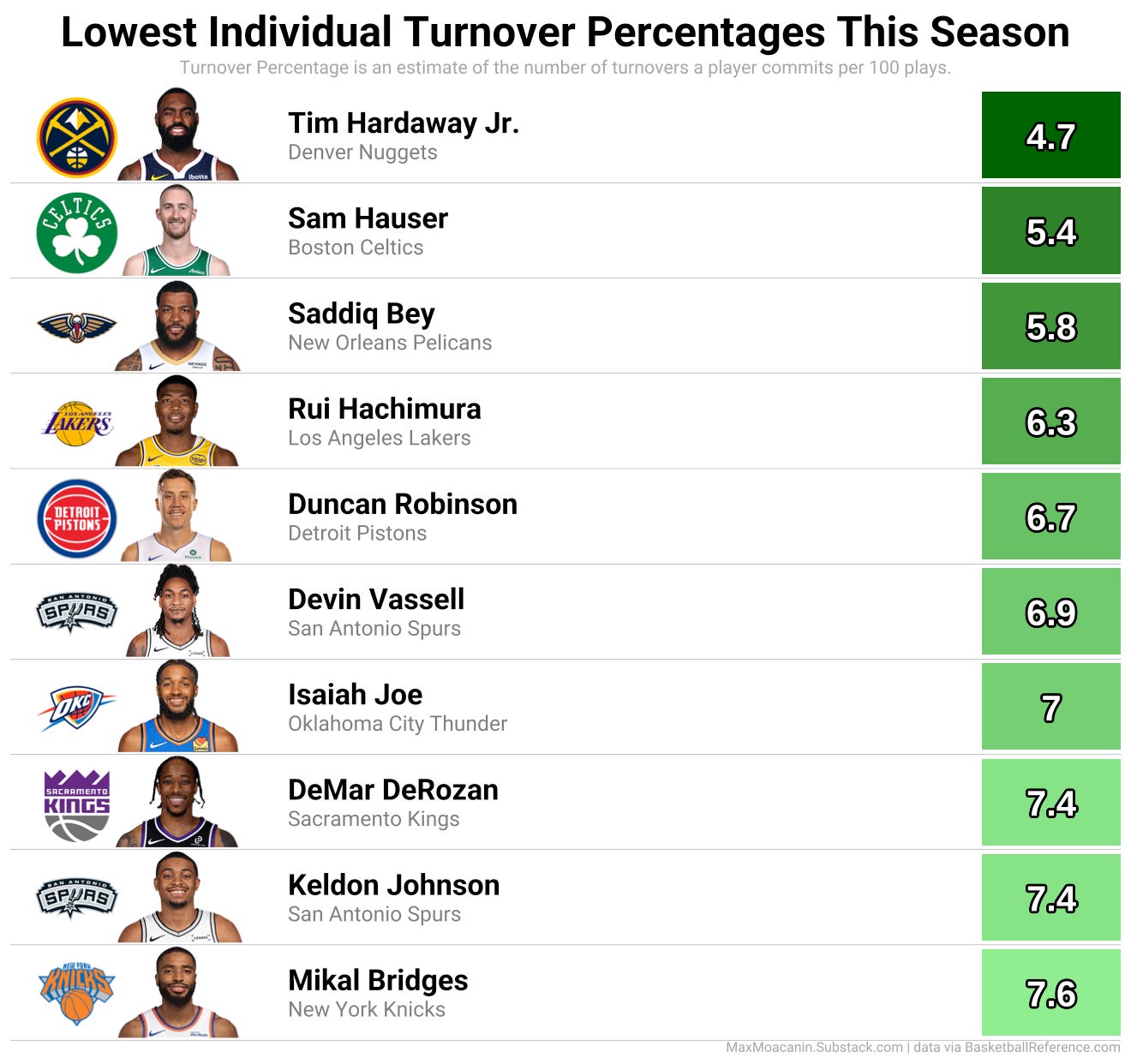
This has been huge for the Nuggets because reducing turnovers has value on both ends of the floor. As I’ve mentioned before, when a team turns the ball over, they don’t just sacrifice an opportunity to score, they also create a high value opportunity for their opponent on the other end. According to Inpredictable, teams averaged 1.31 points per possession this season after a turnover compared to just 1.1 after a made basket and 1.15 after a defensive rebound. In other words, Hardaway’s low turnover percentage is valuable to Denver’s defense as well as their offense.
Lastly, Hardaway’s quick trigger creates opportunities for his teammates.
Because he shoots both quickly and efficiently, defenders can’t afford to leave him. Every time he’s spotted up on the perimeter, one wrong step could turn into three points.
That kind of off-ball gravity matters, especially on a team with Nikola Jokić and Jamal Murray. The less help defense opponents can send, the easier everything else becomes: fewer double-teams on Jokić, cleaner driving lanes for Murray, and simpler decisions across the board.
According to NBA.com, Hardaway ranked 31st in the league in off-ball perimeter gravity this season, and sixth among players who logged fewer than 28 minutes per game. Even in a limited role, he consistently forced defenses to stay honest.
Tim Hardaway, Jr. has been a great addition to my favorite team this season.
His ability to come in off the bench and take quick threes has made the Nuggets offense more efficient in multiple ways: direct scoring, fewer turnovers, and more space for his teammates.
The Nuggets still have a tough path to a title. They’ll likely have to go through the Wolves, Spurs, and Thunder just to make the Finals. But they’re better equipped than they were a year ago. And considering they pushed the eventual champions to seven games last season, that’s enough to make this run very interesting.
I love how green his light has been! Just hoping he stays hot in the Playoffs